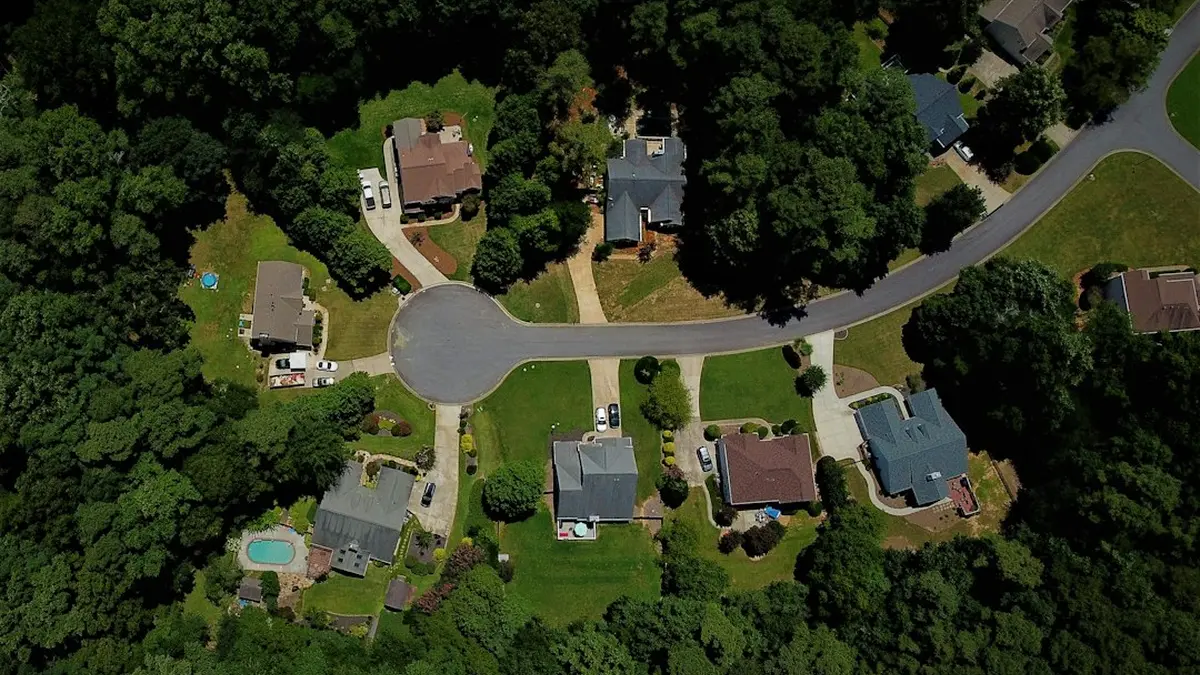
A USDA loan is open to you only if two things are true. The home has to sit inside an area USDA's map marks as eligible. Your whole household's income has to be at or below the limit for that county. Since July 13, 2026, that limit in most counties is $122,800 for a household of one to four people and $162,100 for five to eight. If either test fails, the zero-down offer is off the table, so check both before you start touring homes.
These two tests come before credit and before pre-approval. A lender runs both when it submits your file to USDA's Guaranteed Underwriting System (GUS). You can run them yourself in about ten minutes.
Two tests, run in this order
Start with the address. USDA's official lookup at eligibility.sc.egov.usda.gov lets you type in a specific address. Areas shaded red are ineligible, and these are usually urban or metro locations. The map is built on USDA Rural Development's property eligibility dataset. Its boundary file was last updated January 24, 2024, and is based on the 2020 Census.
Whether a place counts as rural depends mostly on its population:
- Under 10,000 residents: eligible automatically.
- 10,001 to 20,000 residents: eligible only if the place is outside a Metropolitan Statistical Area and shows a mortgage credit shortage.
- 20,001 to 35,000 residents: eligible only if the place was classed as rural in the 1990, 2000 or 2010 Census and lost that status as it grew.
The map also checks the house itself. A USDA appraisal looks for:
- a structurally sound home
- working heating, electrical and plumbing
- safe access by a paved or all-weather road
The home must be a single-family house that you will live in as your primary residence. Investment properties, rentals and vacation homes do not qualify.
Then check income. For the guaranteed program, total household income cannot exceed 115% of area median income, according to USDA Rural Development's program page. "Household" is the part that catches people out. The limit counts every adult who lives in the home, whether or not they are on the loan. It also counts wages, benefits, investment income and rental income.
In most counties the current limits are $122,800 for one to four people and $162,100 for five to eight. High-cost areas, including parts of California, Florida and New York, get higher limits. For households larger than eight, add 8% of the one-to-four-person limit for each extra person.
If you see $119,850 and $158,250 quoted elsewhere, those are the earlier figures. They were replaced on July 13, 2026.
What the fees add, on a hypothetical $250,000 home
Say you buy a $250,000 home with nothing down. USDA charges a 1% upfront guarantee fee, which you can roll into the loan. It also charges a 0.35% annual fee, paid monthly with your mortgage, which does the job PMI does on a conventional loan. These fee figures are as reported by USDALoans.com for 2026.
| Purchase price | $250,000 |
|---|---|
| Down payment | $0 |
| Upfront fee (1%), financed | $2,500 |
| Loan amount | $252,500 |
| Annual fee (0.35%), first year | about $884 |
| Annual fee per month | about $74 |
You need no cash for the down payment or the upfront fee. Your monthly payment carries roughly $74 more than principal, interest, taxes and insurance would on their own. The annual fee is figured on the balance, so treat this as a first-year estimate.
Passing both tests does not approve you. Your lender still checks your debt-to-income ratio (DTI), which compares your monthly debts to your gross monthly income. The usual caps are:
- 29% of gross monthly income for housing (PITI: principal, interest, taxes and insurance)
- 41% for all debts combined
On $8,000 a month, that is $2,320 for housing and $3,280 in total. Lenders may allow higher ratios if you have strong credit and cash reserves.
USDA sets no official minimum credit score. Most lenders want about 640 for automated approval through GUS. Manual underwriting may be possible from 580 to 639, but approval is harder.
Where the limits bite
Suburbs you would assume are urban. Roughly 97% of U.S. land area falls inside the map, by most lenders' estimates. One source, USDALoans.com, puts the figure at 74%. Either way, the eligible land holds only about 35% of the population. In practice, pockets of the suburbs around Phoenix, Las Vegas, Tampa, Charlotte, Austin, Houston and Dallas still qualify. Check the exact address, not the city name.
Lines that move. Eligibility can shift as population data updates. One lender's guide puts it plainly: "Neighborhoods that didn't qualify last year might qualify now, and vice versa." A street you ruled out last year is worth checking again.
Files caught mid-change. Pennymac's Announcement 26-82 confirmed that the new limits apply to any GUS submission or resubmission on or after July 13, 2026. That includes loans already in progress. If you were over the old limit in spring by a small amount, you may fit now.
Guaranteed or direct?
Most first-time buyers who say "USDA loan" mean the guaranteed program, which private lenders offer. The direct program is a separate, subsidized loan made by USDA itself. It has a lower income cap. Its limits are published county by county. One further difference: the income limit is not a loan limit. Guaranteed loans have no set maximum amount. How much you can borrow is decided by your income and your ability to repay.
| Guaranteed (Section 502) | Direct (Section 502) | |
|---|---|---|
| Who lends | USDA-approved private lenders | USDA Rural Development |
| Income cap | 115% of area median income | About 80% of area median income |
| Down payment | 0% | 0% |
| Maximum loan | None set; based on what you can repay | $419,300 standard areas, up to $970,800 high-cost (as of March 2026) |
| Who it suits | Moderate earners in eligible areas | Very low and low earners who can wait for USDA processing |
Before you call a lender
Do these four things first:
- Run the exact address of any home you are serious about through the USDA map.
- Add up the income of every adult who will live there, not just the borrowers.
- Compare that total with your county's figure on the official lookup, not with a number from an article. If you are within a few thousand dollars of the limit, ask the lender how it calculates adjusted income before you rule yourself out.
- Work out your DTI against the 29% and 41% caps.
USDA is wrong for you if the home is in a red-shaded area, if someone in your household earns enough to push you over the limit, or if you want a rental or a second home. If your credit is under 640 and you would rather not rely on manual underwriting, compare the bar to qualify for an FHA loan. If your income is over the limit, compare a conventional loan's requirements, where the down payment can be as low as 3%.
If both tests pass, the next step is finding out what a lender will actually approve.
How does USDA compare with VA, FHA and conventional low-down options?
The zero-down guide sets every no-down and low-down path side by side, so you can see which one fits your situation.
Read the zero-down options guide
Comments
No comments yet. Be the first to comment!
Leave a Comment